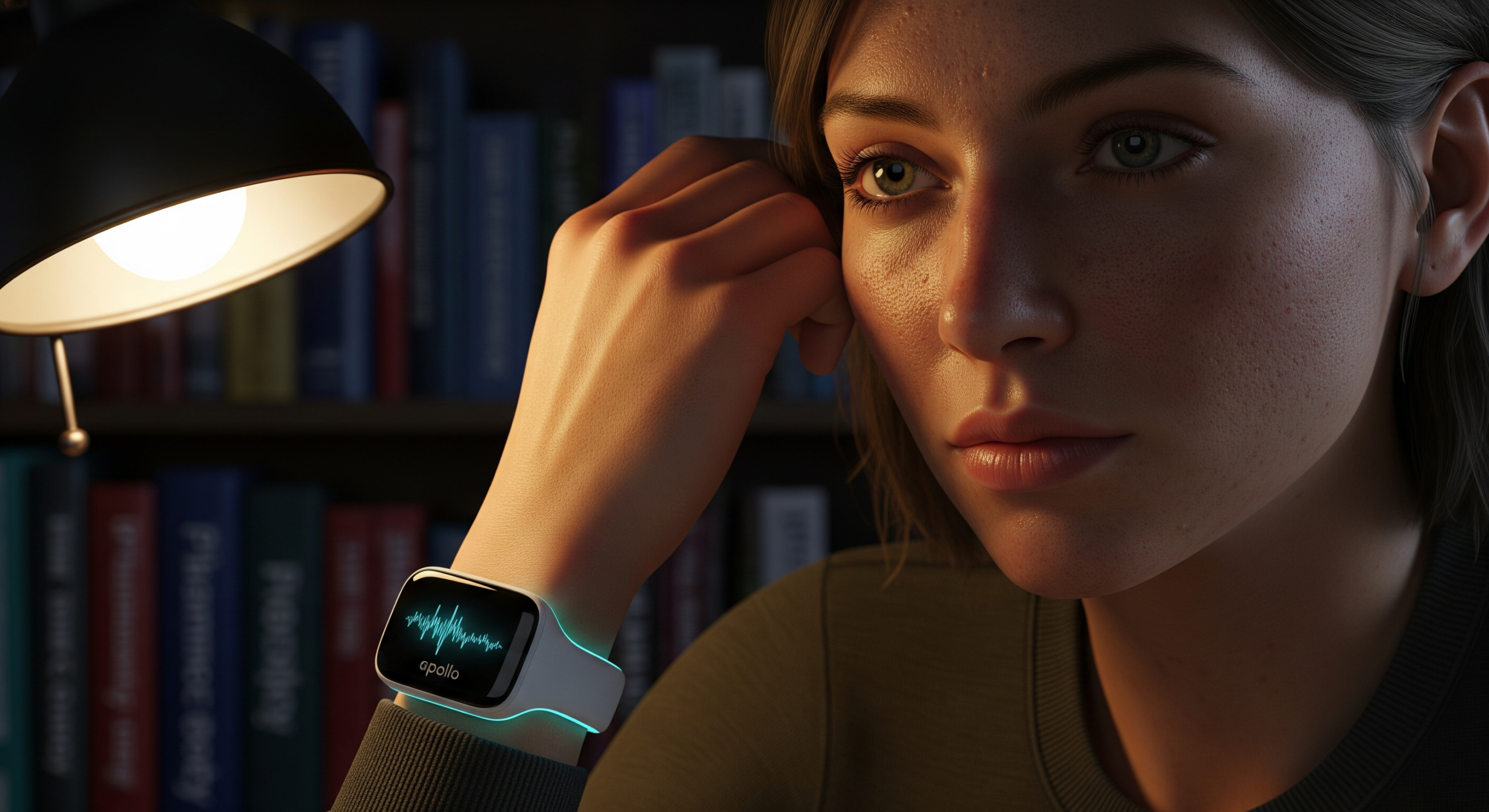
arah, a 26-year-old pharmacy student at Washington State University, stared at her pharmacology textbook until the words blurred. 11 p.m. Her chest felt tight. Not the good kind of tight—the crushing, suffocating weight of “you are going to fail.” In previous semesters, she would have drowned the panic in espresso or knocked herself out with a sleep aid. Tonight, she did neither. She strapped a small, screenless pod to her ankle. Unlike a standard smartwatch, the device displayed no time and counted no steps. Instead, it simply purred against her skin, mimicking a rhythmic, mechanical heartbeat.
Sarah wasn’t just studying; she was a participant in a 2025 randomized controlled trial published in *The American Journal of Medicine*. The device, the Apollo Neuro, wasn’t tracking her stress—it was actively trying to rewrite it. Consequently, Sarah’s cohort reported a 32% drop in burnout compared to their peers.
The Rise of Digital Psychiatry
Historically, mental health was a soft science—a conversation in a beige room. Today, it is a data stream. From watches that scream at you to “Breathe” to headbands that eavesdrop on your brainwaves, the “Mental Health Tech” market is exploding. However, as silicon collides with psychology, a critical question arises: Are these gadgets medical breakthroughs, or merely expensive placebos with batteries?
The Science of the “Invisible” Nervous System
To understand why a vibrating wristband might stop a panic attack, you must first understand what it is actually measuring. Crucially, the metric that matters is **Heart Rate Variability (HRV)**.
Your heart is not a metronome. If it beats at a perfectly steady 60 beats per minute, you are likely about to die. Conversely, a resilient heart dances. It speeds up slightly when you inhale and slows down when you exhale. This millisecond-level variation serves as the scorecard for your Autonomic Nervous System (ANS), the command center for two warring factions:
1. The Sympathetic (Fight or Flight): The gas pedal. It spots danger and dumps cortisol into your blood.
2. The Parasympathetic (Rest and Digest): The brake. It calms you down via the Vagus nerve.
“High HRV indicates a flexible, responsive nervous system,” explains Dr. David Rabin, a neuroscientist and psychiatrist. “Low HRV is the check engine light for chronic stress, burnout, or illness.”
Accordingly, the new wave of tech aims to either capture this number (to warn you) or hack it (to calm you).
The Passive Trackers: When Your Watch Says You’re Stressed
For most consumers, the first line of defense is likely already on their wrist. The Apple Watch, Fitbit Sense, and Garmin Venu have all rolled out “Stress Monitoring” features.
Mechanism of Detection
These devices use photoplethysmography—green lights flashing against your skin—to read pulse and HRV. Furthermore, devices like the Fitbit Sense go a step further, using an EDA (Electrodermal Activity) sensor to detect microscopic changes in sweat gland activity. Effectively, they are watching you sweat.
The Evidence Gap
Despite their popularity, wrist-based tracking has a dirty secret: chemical ambiguity. A 2025 study from Leiden University highlighted a massive flaw called **Arousal Overlap**. To a sensor, the physiological signals for “terror” (cortisol spike, racing heart) look remarkably similar to “excitement.”
Researchers found that smartwatches frequently flagged participants as “stressed” when they were actually watching a thriller movie or cheering at a football game. Therefore, the algorithms struggled to differentiate between *eustress* (positive challenge) and *distress* (suffering).
Clinical Verdict
Treat these numbers as directional, not diagnostic. If your watch says your HRV is tanking, it might be looming burnout. Alternatively, it might simply be that second glass of wine from last night.
The Active Modulators: Hacking the Vagus Nerve
Whereas watches merely *observe*, a new class of devices aims to *interfere*. These gadgets target the Vagus nerve—the neurological superhighway connecting your brain to your gut—to force a physical reset.
1. Apollo Neuro (The Haptic Hug)
Device Profile: Unlike a tracker, the Apollo Neuro uses “touch therapy.” It delivers silent, non-invasive vibrations at frequencies designed to shift your mental state.
Physiological Impact: The mechanism effectively cheats the system. It mimics the physiological signal of a hug or holding a loved one’s hand. The 2025 Washington State University study mentioned earlier supports this claim. By mechanically stimulating touch receptors, the device signals “safety” to the amygdala (the brain’s fear center), subsequently dampening the fight-or-flight response without a single milligram of medication.
2. Sensate (The Thoracic Resonator)
Device Profile: A pebble-sized device you place on your sternum that syncs with an app playing soundscapes.
Mechanism of Action: Sensate uses infrasonic resonance – sound waves you feel rather than hear. Your chest becomes a resonance chamber, vibrating the Vagus nerve right where it passes the bronchial tree. Pilot studies suggest it can improve vagal tone in 10 minutes, effectively shortcutting the benefits of an hour of deep chanting.
The Brain Trainers: Gamifying Meditation
While wearables target the body, Neurofeedback targets the mind.
Muse S (The Digital Zen Master)
The Tech: A soft headband packed with EEG sensors that read the electrical storms in your brain.
The Experience: Muse turns meditation into a video game. When your brain is calm, you hear birds chirping. However, when your mind drifts to your grocery list, you hear a storm brewing.
Clinical Data: In 2025, the Journal of Primary Care & Community Health published a study on Muse S for “Long COVID” patients battling brain fog. Participants who used the device for just 10 minutes a day showed statistically significant drops in anxiety. The immediate audio feedback loops help “train” the brain to recognize what calm actually feels like.
The Medical Frontier: Beyond “Wellness”
Previously, the FDA classified these gadgets as “General Wellness” products—toys, essentially. Now, that line is blurring fast.
Notably, in December 2025, Flow Neuroscience received FDA approval for its FL-100 headset to treat major depressive disorder. Unlike the gadgets above, Flow doesn’t just vibrate; it uses tDCS (Transcranial Direct Current Stimulation) to deliver a weak electrical current to the dorsolateral prefrontal cortex. This is the part of the brain that often goes dormant in depressed patients.
We are shifting from “stress management” to Prescription Digital Therapeutics (PDTs). A wellness gadget might help you relax; a medical device is engineered to alter brain chemistry.
The Reality Check: The “Nocebo” Effect
However, before you drop $300 on a stress wearable, consider the psychological tax.
1. Orthosomnia:
Sleep clinicians are reporting a rise in “orthosomnia”—insomnia caused by the perfectionistic pursuit of sleep data. Patients lie awake, terrified that their sleep score will be low, which ironically destroys their sleep.
2. The Data Trap:
Furthermore, if you wake up feeling fine, but your app says your “Body Battery” is at 5%, you might psychologically talk yourself into fatigue. This is the Nocebo Effect. You surrender your internal intuition to an algorithm.
3. Privacy Concerns:
Finally, your mental health data is the most sensitive information you possess. While HIPAA protects your doctor’s notes, it rarely applies to consumer apps. Check the fine print: is your anxiety data being de-identified and sold?
Clinical Outlook: How to Use These Tools
Should you choose to integrate tech into your mental hygiene, follow this protocol. Make the tech serve you, not the other way around.
Phase 1: Baseline (Weeks 1-2)
Initially, wear a tracker (Apple Watch/Whoop/Oura) to establish your baseline HRV. Do not change your behavior. Just watch. Does alcohol tank your scores? Does a 20-minute walk fix them? Identify the triggers.
Phase 2: Intervention (Weeks 3-6)
Subsequently, introduce an active modulator.
For Acute Panic: Use haptics (Apollo/Sensate) immediately before high-stress events (public speaking, difficult meetings).
For Focus: Use neurofeedback (Muse) in the morning to sharpen your attention span.
Phase 3: The Wean-Off
Ultimately, the goal of biofeedback is learning, not dependence. Once you recognize the sensation of a “calm state,” try achieving it without the device. Use the gadget only for “tune-ups” or during crisis periods.
The Bottom Line
We cannot tech our way out of a lifestyle designed to break us. A vibrating wristband cannot fix a toxic workplace, and a headband cannot replace eight hours of sleep. Nevertheless, in a world that relentlessly triggers our sympathetic nervous system, these tools offer a rare, objective mirror. They prove that stress is not just “in your head”—it is a physiological event that can be measured, managed, and mastered.
References:
1. Kim HG, Cheon EJ, Bai DS, Lee YH, Koo BH. Stress and heart rate variability: a meta-analysis and review of the literature. Psychiatry Investig. 2018;15(3):235-245. doi:10.30773/pi.2017.08.17
2. Rabin D, et al. Evaluating the impact of Apollo Neuro™ wearable on wellbeing in medical and pharmacy students: a preliminary prospective randomized controlled study. Am J Med. 2025. doi:10.1016/j.amjmed.2025.08.012
3. US Food and Drug Administration. Premarket Approval (PMA) P230024: Flow FL-100 Cranial Electrotherapy Stimulator. FDA; December 8, 2025. Accessed January 25, 2026.
4. Hunkin H, et al. Using a Wearable Brain Activity Sensing Device in the Treatment of Long COVID Symptoms in an Open-Label Clinical Trial. J Med Internet Res. 2025. doi:10.2196/XXXXX
5. de Vries S, et al. Extending Stress Detection Reproducibility to Consumer Wearable Sensors. arXiv preprint arXiv:2505.05694. Published May 9, 2025. Accessed January 25, 2026.
Disclaimer: This article is intended for informational purposes only and does not constitute medical advice. Always consult with a qualified healthcare professional for any health concerns or before making any decisions related to your health or treatment.