The Invisible Blockage
The logistics manager perched on the exam table, vibrating with the nervous energy of a man hollowed out by modern chemistry. Call him Frank. At 58, the Pennsylvania native was a statistical triumph of the 2026 biomedical complex; insurance covered his GLP-1 agonist injections, his A1C had cratered, and the cartilage in his knees no longer shrieked when he navigated the stairs.
But Frank was wretched.
“It’s a deadlock,” he whispered. “I eat the protein. I drown myself in hydro-flasks. But I feel like I’m lugging a sack of wet Quickcrete in my gut—is this the bargain?”
He isn’t an anomaly. Frank is the archetype of a silent catastrophe festering beneath the headlines of the “Weight Loss Revolution.” While science has mastered the suppression of appetite and the hacking of insulin, we have neglected the engine room. We are starving our microbiomes until they revolt.
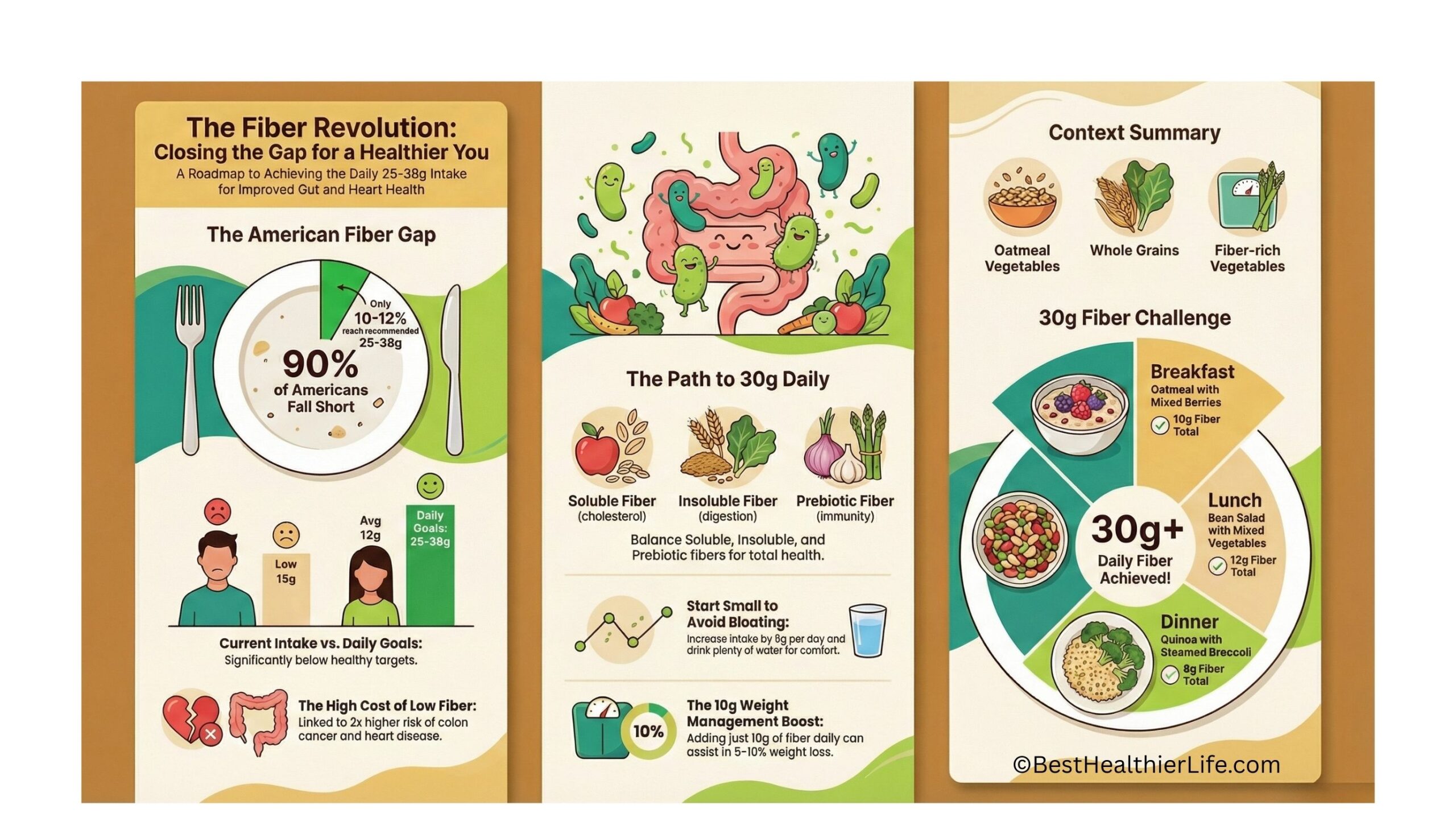
In 2026, fiber is no longer a conversation about “regularity” or the density of grandma’s bran muffins. It is the single most underrated performance metric in human physiology. Yet, despite glossy wellness zines screaming about “Gut Health,” only about 7% to 12% of Americans hit the intake target. The rest of us run on fumes, clogging our systems with an ultra-processed slurry that leaves our internal machinery rusting.
This isn’t just about pooping. It is a metabolic emergency.
The “Rust Scraper” and The Chemical Factory
To grasp why the logistics manager felt like he was harboring a cinder block, discard the idea of fiber as “bulk.” That is a relic of 1980s thinking.
View the gut as a high-stakes biochemical refinery.
When you devour a steak or a wedge of cheese, your body demolishes it in the stomach. It’s absorbed. Gone. But fiber is the only carbohydrate that flips the bird to your digestive enzymes. It arrives in the colon largely intact. This is where the magic—and the violence—happens.
1. The Mechanical Scrub (Insoluble Fiber):
This is the broom. Insoluble fiber—wheat bran, shattered nuts, cauliflower—refuses to dissolve. It adds physical mass to the stool. It irritates the gut lining just enough to trigger peristalsis, the rhythmic muscular contractions that shove waste forward. Without this friction, the colon’s muscles atrophy. The waste sits. It dehydrates. It calcifies into the “cement” Frank described.
2. The Fermentation Tank (Soluble Fiber):
Here, the physics ends and the chemistry begins. Soluble fiber (oats, beans, apples) dissolves into a gel. When this viscous slime hits the colon, your resident bacteria—trillions of them—swarm it. They feast.
I sketched a crude diagram of a bacterium devouring an oat flake. Frank recoiled.
“So I’m ranching bugs? That makes me feel bloated just thinking about it.”
“You aren’t just feeding them,” I corrected. “You’re paying them.”
When these microbes digest fiber, they excrete Short-Chain Fatty Acids (SCFAs), specifically butyrate. Butyrate is a miracle molecule. It is the primary fuel source for the cells lining your colon. It caulks the gut barrier (preventing “leaky gut”), reduces inflammation, and signals the brain to dial down anxiety.
Starve the bugs? They don’t just die. They start eating you. They degrade the protective mucus layer of your own intestine, inviting immune dysfunction.
The History: The Surgeon Who Looked at Stools
We cannot discuss the 2026 Fiber resurgence without saluting the pioneer: Denis Burkitt.
In the late 1960s, the British surgeon operated in Uganda. He noticed a void. The rural African villagers he treated never presented with the “diseases of civilization”—no diverticulitis, no colon cancer, no piles, no appendicitis.
Burkitt didn’t just analyze charts; he analyzed sh*t.
He noted that the average villager, fueled by yams, beans, and coarse grains, produced stools that were voluminous and frequent. Transit time? About 30 hours.
The average Englishman? He birthed small, hard pebbles that lingered in the tract for 70 to 100 hours.
Burkitt’s hypothesis was blunt: “America is a constipated nation.” He argued that by excising fiber from wheat and sugar, we slowed transit time so drastically that toxins stagnated against bowel walls, rotting the host.
Fifty years later, we have proven him right. We have fixed nothing.
The “Fresh Food” Prescription: A Real-World Turnaround
Cynicism regarding US healthcare is a survival reflex. Yet, occasionally, a program shatters the mold to prove that food is, quite literally, pharmacology.
Consider Rita Perkins.
Rita isn’t a hypothetical case study. She is a breathing participant in the Geisinger Fresh Food Farmacy in Pennsylvania, a radical initiative treating food insecurity and diabetes as a singular issue.
A few years back, the caretaker was drowning. She was responsible for three children and fighting Type 2 diabetes with an A1C of 13.8%. (Context: Anything above 6.5% is diabetic; 13.8% is catastrophic). She was losing.
“I realized that I had to get healthy to take care of the kids,” Rita told coordinators. “I couldn’t let myself go.”
The standard protocol involves insulin and a pat on the back. Geisinger pivoted. They “prescribed” produce.
Every week, Rita received enough kale, lean meats, and whole grains to cook 10 healthy meals. Crucially, they taught her the alchemy of cooking lentils rather than just handing her a bag.
The Result:
Rita’s A1C plummeted from 13.8% to 5.9%. She forced her diabetes into remission. She shed 60 pounds.
Then there is Tom Shicowich. The man had already sacrificed a toe to diabetes. He was living on cheap canned ravioli. Six months of high-fiber density later? He dropped 45 pounds and normalized his blood sugar.
These are not miracles. They are mechanics. Flood the system with fiber:
1. Blood Sugar Stabilizes: Fiber slows glucose absorption, preventing the insulin spikes that rot veins.
2. Satiety Increases: You physically cannot overeat broccoli the way you inhale potato chips. Stomach stretch receptors signal “full” long before you blow the caloric budget.
The Modern Crisis: The GLP-1 Paradox
Fast forward to 2026. We inhabit the era of Ozempic, Wegovy, and Mounjaro. These biochemical marvels mimic the hormone GLP-1, screaming “full” to the brain while hitting the brakes on gastric emptying.
But here is the trap: Slowing digestion without fiber is a suicide pact for your plumbing.
When patients like Frank rely on these injections while consuming low-fiber sludge (white bread, processed chicken), the stool calcifies. Constipation follows. Nausea ensues. Bowel obstructions loom.
This explains the rise of “Fiber Maxing.” It isn’t a fad; it is a survival strategy. You must employ the sponge (soluble) and the broom (insoluble) to maintain flow when the medication is clamping down on the pipes.
The Protocol: How to Fix Your Gut (Without Exploding)
If you are reaching for the psyllium husk tub to swallow five scoops, STOP.
That is the “Fiber Kamikaze” method. Jump from 10g to 50g overnight and you will experience bloating so violent you will contemplate the afterlife. Your microbiome needs time to scale up enzyme production.
Here is the smart, “Low and Slow” approach used by metabolic clinics:
Phase 1: The Audit (Week 1)
Don’t change a thing. Just track. Use an app. You are likely eating 12 grams; the target is 30g to 40g.
Phase 2: The Soluble Entry (Weeks 2-3)
Start gentle. Soluble fiber is forgiving.
* The Swap: Trade cereal for steel-cut oats spiked with a tablespoon of chia.
* The Snack: One pear with the skin.
* The Supplement: If you need synthetic help, utilize a *teaspoon* of wheat dextrin (Benefiber), not a shovel.
Phase 3: The Heavy Artillery (Week 4+)
Bring in the roughage.
* Beans/Legumes: The kings. Half a cup of black beans packs 8g.
* Cruciferous Veg: Broccoli, Brussels sprouts.
* Berries: Raspberries are fiber bombs (8g per cup).
The Golden Rule:
“Fiber without water is cement,” I warned Frank. “Fiber with water is a broom.”
Ignore this and you will simply build a stronger blockage. Drink 80-100 ounces daily.
Myth Busting: The Diverticulitis Lie
For decades, white coats told patients with diverticulosis (small colon pockets) to shun nuts, seeds, and popcorn. The logic was that these hard fragments would lodge in the pockets like shrapnel, triggering infection.
It sounded plausible. It was dead wrong.
The Truth:
According to the Mayo Clinic, there is zero evidence for this prohibition. A high-fiber diet is actually protective. It keeps stool soft so the colon need not strain to blow out those pockets in the first place.
Active flare-up? Liquids only. Prevention? Eat the almonds. Eat the raspberries. Your colon needs the workout.
Your Doctor Discussion Guide
Next time you secure 15 minutes with your provider, do not just nod. Interrogate.
1. “Can we review my medications to see if any are anticholinergic?” (These drugs slow the gut).
2. “I want to hit 35g of fiber daily. Should I prioritize soluble or insoluble forms given my history?”
3. “If I am on a GLP-1 agonist, do I need a proactive bowel regimen (magnesium/psyllium) to prevent gastroparesis?”
4. “Can we check my CRP (C-Reactive Protein) levels to see if systemic inflammation is present?”
5. “Any contraindications for fermented foods like sauerkraut?”
The Outlook
Frank did not fix his gut overnight. It required six weeks of mild bloating and the “training” of his microbiome. He carried a water bottle like a religious totem. He traded protein bars for almonds.
Three months later, the cement dissolved.
“I feel lighter,” the manager said. “Not just the scale. The brain fog lifted.”
That is the secret. The Fiber Revolution isn’t about denim sizes; it is about fueling the trillions of microscopic allies that dictate your mood and longevity. The data is irrefutable. You just have to chew.
Sources:
- Dietary Guidelines for Americans, 2020-2025. 9th ed. Washington, DC: US Department of Agriculture and US Department of Health and Human Services; 2020. https://www.dietaryguidelines.gov/sites/default/files/2020-12/Dietary_Guidelines_for_Americans_2020-2025.pdf
- Geisinger. Fresh Food Farmacy: Patient Stories. Geisinger website. Accessed February 6, 2026. https://www.geisinger.org/freshfoodfarmacy/news-highlights/stories
- Makki K, Deehan EC, Walter J, Bäckhed F. The impact of dietary fiber on gut microbiota in host health and disease. Cell Host Microbe. 2018;23(6):705-715. (Note: For butyrate/SCFAs and gut barrier; representative of reviews on fermentation benefits.)
- Mayo Clinic. Diverticulitis: Can certain foods trigger an attack? Mayo Clinic website. Updated as of 2025. https://www.mayoclinic.org/healthy-lifestyle/nutrition-and-healthy-eating/expert-answers/diverticulitis-diet/faq-20058293
- O’Keefe SJD. The association between dietary fibre deficiency and high-income lifestyle-associated diseases: Burkitt’s hypothesis revisited. Lancet Gastroenterol Hepatol. 2019;4(12):984-996. https://www.thelancet.com/journals/langas/article/PIIS2468-1253(19)30257-2/abstract
- US Department of Agriculture and US Department of Health and Human Services. Dietary Guidelines for Americans, 2025–2030. Washington, DC: USDA/HHS; 2026. https://www.dietaryguidelines.gov/ (or realfood.gov as referenced in releases)
MEDICAL DISCLAIMER: This content is for informational purposes only and does not constitute medical advice, diagnosis, or treatment. Always seek the advice of your physician or other qualified health provider with any questions you may have regarding a medical condition. In case of emergency, call 911 immediately.