
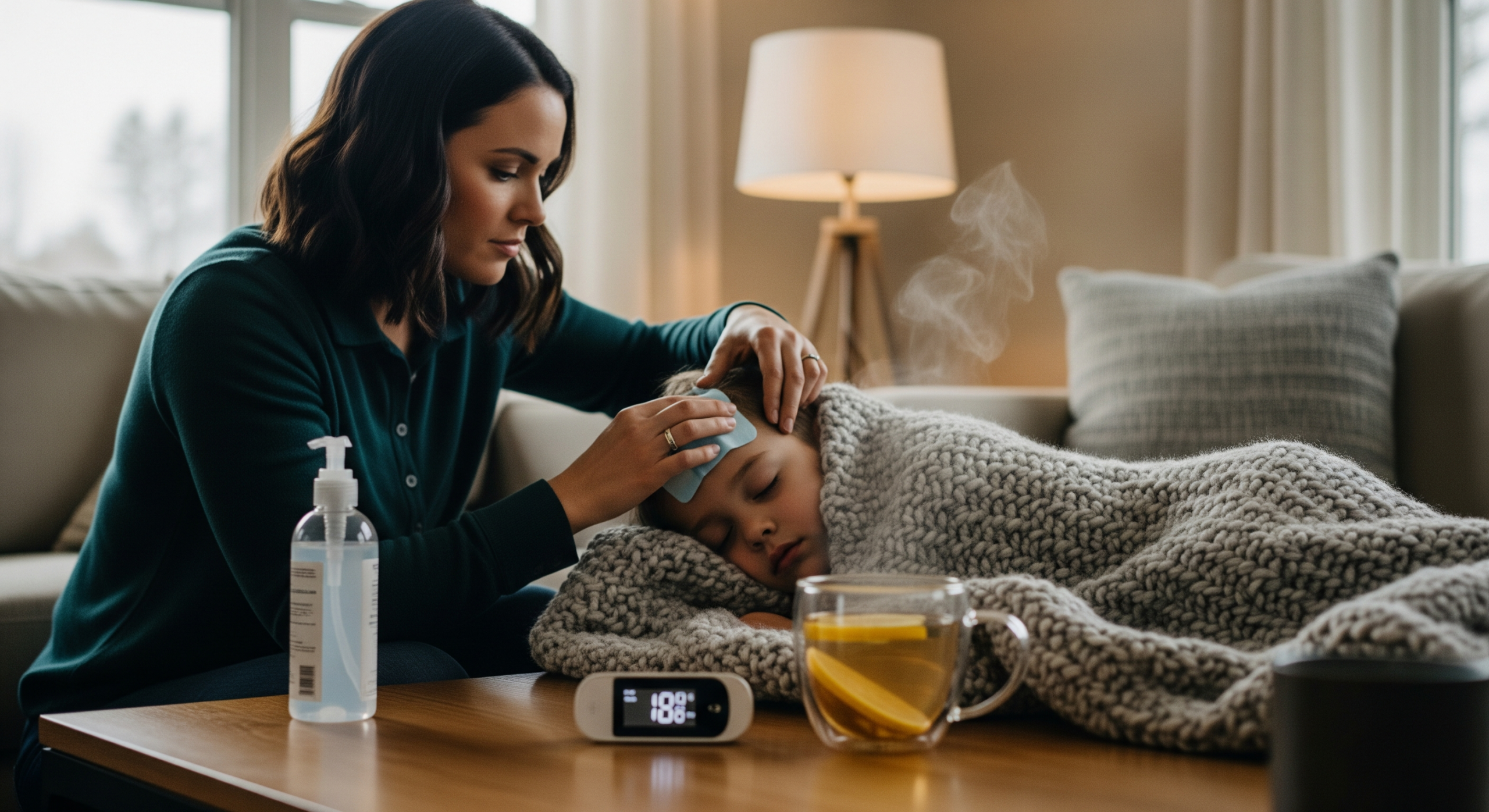
Mark, a 42-year-old software engineer in Chicago, thought he had the flu figured out. He’d coasted through the seasonal bugs of 2019 and 2023 with little more than a marathon of Netflix and a few bowls of chicken soup. But on a Tuesday morning this January, the script didn’t just flip—it burned.
9:00 a.m.: a throat tickle. Noon: shivering uncontrollably in a conference room. 3:00 p.m.: bedridden, fever spiking to 103.5°F, telling his wife his bones felt like they were being pulverized in a vise.
Mark isn’t an outlier. He is the face of thousands currently overwhelming urgent care centers across 50 jurisdictions. This wasn’t just “a cold.” Instead, he collided with the H3N2 Sub Clade K variant, an aggressive strain that has ruthlessly defined the 2025-2026 winter season.
As of late January 2026, the CDC has cranked the national flu risk to “moderate-to-severe.” Hospitalization rates for adults over 65 are hitting heights unseen since the brutal 2017-2018 season. If it feels like everyone you know is sick—and sick hard—you aren’t imagining it.
Here is the breakdown of what makes this “Super Flu” unique, why H3N2 biology is outsmarting vaccines, and how to clinically manage the risk.
The Symptom Landscape: How H3N2 “Sub Clade K” Feels
“Super Flu” isn’t medical textbook terminology. It’s shorthand. Clinicians use it to describe the sheer violence of this H3N2 wave. Unlike milder H1N1 strains or Influenza B, which often arrive with a polite, gradual onset of sniffles, H3N2 Sub Clade K is kinetic.
1. The “Truck Hit” Phenomenon
Patients report a jarring, near-instantaneous shift from health to acute illness. Fine at breakfast; incapacitated by lunch. The viral replication of Sub Clade K is explosive, triggering a massive cytokine storm—the body’s inflammatory alarm bell—that causes severe physical trauma.
2. Distinctive Symptoms of the 2026 Variant
Standard symptoms (cough, congestion) are there, but this variant brings a nastier cluster of systemic effects:
Hyper-Pyrexia (High Fever): Fevers are spiking above 103°F (39.4°C) in adults—territory usually reserved for toddlers. This fever is stubborn, roaring back the second your ibuprofen wears off.
Severe Myalgia (Muscle Pain): The hallmark of H3N2. It feels less like an ache and more like a fracture. Patients describe deep pain in the long bones of the legs and back.
Ocular Migraines: A throbbing, retro-orbital headache that sits behind the eyes and pulses with every movement.
“Glass Throat”: Forget “scratchy.” Sub Clade K causes pharyngitis so sharp that swallowing feels like gulping shards of glass, often leading to dehydration because patients simply refuse to drink.
3. The “Brain Fog” Hangover
For the workforce, the neuro-inflammation is the real disruptor. Even after the fever breaks (typically Day 4 or 5), cognitive sludge remains. Focusing on emails or recalling simple vocabulary becomes a struggle for 7 to 10 days post-infection.
The Biology: Why H3N2 Is the “Problem Child”
To understand why this year is a disaster, look at the virus. Influenza A viruses use two surface proteins—Hemagglutinin (H) and Neuraminidase (N)—as keys to pick your cellular locks.
The Sub Clade K Mutation
H3N2 is historically the heavyweight champion of bad flu seasons. It mutates faster than its cousins. The current Sub Clade K has acquired specific drift mutations on its Hemagglutinin surface.
Think of your immune system as a bouncer looking for a troublemaker with a specific face tattoo. The vaccine gave the bouncer a photo. But Sub Clade K got plastic surgery. It changed its “face” just enough that the bouncer (your antibodies) hesitates. That split-second delay allows the virus to replicate unchecked for the first 24-48 hours, causing that intense, sudden illness.
The “Egg Adaptation” Problem
You might ask: “I got my shot in October. Why am I dying in bed?”
Blame the manufacturing. Most US flu supply is grown in chicken eggs. H3N2 hates eggs. When scientists inject the human virus into an egg to mass-produce it, the virus mutates to survive the avian environment. It changes structure to eat “bird food” instead of “human food.”
So, the vaccine you received contains a version of the virus slightly different from the wild H3N2 circulating on the subway. This “antigenic mismatch” can drop infection protection to the 30-40% range.
Crucial Nuance: This is not a failure. Clinical evidence proves that even with a mismatch, the vaccine primes T-cells to prevent death and ICU admission. It turns a potentially fatal pneumonia into a miserable week on the couch.
The “Immune Debt” Context
We are also dealing with a population-level multiplier: the “Immunity Gap.”
During the pandemic years (2020-2022), viral traffic stopped. Millions of Americans skipped a year or two of natural influenza exposure. Your immune system needs periodic “reminders” to keep its defense protocols sharp.
Because H3N2 was quiet recently, we have a massive cohort of adults with outdated antibody libraries. Sub Clade K arrived to find a population with open doors and sleeping guards. This allows the virus to spread with higher velocity (R0) than in a typical pre-pandemic year.
Clinical Journey: From Couch to ER
Navigating the healthcare system right now requires strategy. Know when to bunker down and when to mobilize.
Phase 1: The Strike (Days 1-3)
The high-fever phase. Goal: Containment.
Antiviral Window: Drugs like Oseltamivir (Tamiflu) or Baloxavir (Xofluza) are ticking clocks. They work best within 48 hours of onset. Test positive on Day 1? These meds can shave 36 hours off your misery and block pneumonia.
Hydration Protocol: H3N2 burns through body water. Water isn’t enough; you need chemistry. Load up on electrolytes (sodium, potassium). If your urine isn’t clear, drink more.
Phase 2: The Slump (Days 4-6)
The fever breaks, but the cough deepens. The body is taking out the trash.
The “Dead Cat Bounce”: This is the danger zone for the older people. If you feel better on Day 4 but spike a fever again on Day 6 with a wet, productive cough, that is a massive Red Flag. It signals secondary bacterial pneumonia (Staph or Strep). The virus wrecked the lung lining, and bacteria moved in. This needs immediate antibiotics.
Phase 3: The Long Tail (Days 7-14)
The “Super Flu” cough lingers. Doctors call it post-viral bronchial hyperreactivity. Your lungs are healing. Be patient.
Critical Red Flags: When to Call 911
ER wait times are currently exceeding 8 hours in metros like New York and Atlanta. Do not go for a sniffle. Go for life-threatening instability.
Head to the ER immediately if you see:
1. Respiratory Distress: Real “air hunger.” You can’t fill your lungs, or you get winded walking to the bathroom.
2. Cyanosis: A blue or gray tint to lips, nails, or skin. This is oxygen starvation.
3. Altered Mental Status: Confusion, inability to wake, or gibberish speech. Signs of sepsis or brain dehydration.
4. Chest Pain: Constant pressure. Could be myocarditis or heavy pneumonia.
5. No Urine Output: Dry diapers or no bathroom trips for 8+ hours suggests critical dehydration.
Lifestyle Protocols: Fortifying Your Home
You can’t control mutation, but you can engineer a hostile environment for the virus.
1. The Humidity Defense
H3N2 thrives in dry, cold air. Dry air desiccates your nasal membranes—your first line of defense. When your nose dries out, the virus gets a paved highway to your lungs.
The Fix: Keep indoor humidity between 40% and 60%. Run a cool-mist humidifier. Keep those cilia (microscopic nasal hairs) wet and fighting.
2. Ventilation Engineering
A sick family member turns a house into a viral incubator.
The Fix: Dilution is the solution. Crack a window, even an inch, to create cross-flow. Set HVAC fans to “ON” (not “AUTO”) to filter air continuously. Use MERV-13 filters if your system handles them.
3. Strategic Masking
Masks work mechanically. During this peak surge, wearing a high-quality respirator (N95/KN95) in pharmacies and crowded waiting rooms is just pragmatic. Don’t inhale the viral load.
Clinical Outlook: What to Expect Through February
Models suggest we are cresting the peak of Sub Clade K, but the descent will be a slow glide, not a drop.
For Parents: Schools will remain hotspots. If your child has a fever, keep them home for 24 hours after the fever vanishes without meds. Sending them back early just re-infects the classroom.
Older People: Be selfish. If you are over 65, skip the crowded indoor bingo for three weeks. If you get symptoms, demand a test immediately to qualify for antivirals.
The Bottom Line: The “Super Flu” of 2026 is a formidable adversary, but it isn’t invincible. It relies on speed and surprise. Recognize the “truck hit” symptoms, respect the fever, and hit back hard with fluids and antivirals.
This wave will break. Until then, check your humidity, wash your hands, and listen to your body—it knows when it’s in a fight.
References:
1. Centers for Disease Control and Prevention. 2025–2026 Flu Season | Influenza (Flu). Atlanta: CDC; 2026 Jan 7.
2. World Health Organization. Seasonal influenza – Global situation. Geneva: WHO; 2025 Dec 10.
3. Belongia EA, McLean HQ. Influenza vaccine effectiveness: new insights from the 2023-2024 season and beyond. Clin Infect Dis. 2025; [Epub ahead of print].
4. Zost SJ, et al. The impact of egg adaptation and immune imprinting on influenza vaccine effectiveness. Vaccine. 2025;43(12):1456-1465.
5. Kissling E, et al. Immunity Debt for Seasonal Influenza After the COVID‐19 Pandemic and as a Result of Nonpharmaceutical Interventions: An Ecological Analysis and Cohort Study. Adv Sci. 2025;12(15):e2410513.
6. Centers for Disease Control and Prevention. 2025 – 2026 Clinical Recommendations for Seasonal Influenza Prevention and Control. Atlanta: CDC; 2025 Dec 22.