

Sleep Recession
On an April morning in 2007, Arianna Huffington woke up in a pool of her own blood.
She hadn’t been attacked. She hadn’t suffered a stroke. The media mogul, then at the height of her influence building The Huffington Post, had simply ceased to function. Her body, running on fumes and four hours of nightly rest, initiated a hard reboot. She collapsed at her desk, hitting the corner on the way down, breaking her cheekbone and slashing her eye.
“I was successful by all the standards the world uses to measure success,” Huffington later admitted. “But by any sane definition of success, I was a train wreck.”
For decades, American culture treated sleep as an adversary—a time sink for the lazy, a biological inconvenience to be caffeinated into submission. Wall Street traders bragged about “sleeping when they’re dead.” Medical residents wore their 30-hour shifts like combat medals. But the collapse of a high-profile executive signaled a crack in that facade.
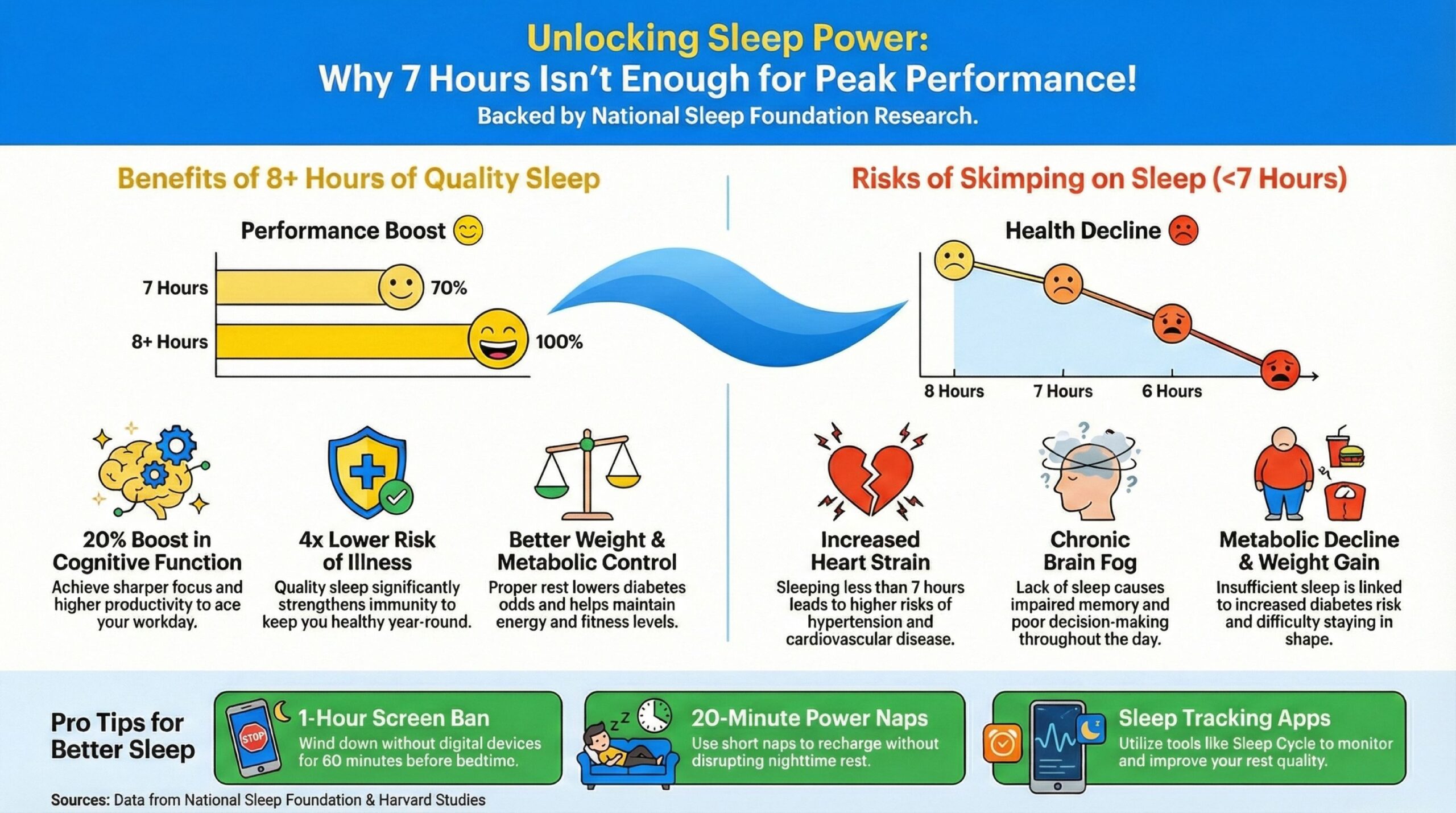
We are now in the middle of a sleep recession. According to the CDC, one in three US adults usually gets less than the recommended amount of sleep. But emerging research from the University of Chicago, the University of Pennsylvania, and major sleep labs suggests the “recommended” seven hours might just be the baseline for survival, not the threshold for thriving.
When you cut sleep, you don’t just get tired. You get sick, you get slow, and biologically speaking, you get old.
The Night Shift: How the Brain Washes Itself
For centuries, scientists assumed the brain just went dormant at night, like a car parked in a garage. They were wrong. The brain is more like a restaurant kitchen after closing time: the real work begins when the customers leave.
In 2013, researchers discovered the glymphatic system, a plumbing network in the brain that runs at high velocity during deep sleep.
Here is the mechanics of it: When you enter non-REM deep sleep, your brain cells actually shrink by up to 60%. This creates space for cerebrospinal fluid to rush through the tissue, washing away metabolic waste products accumulated during the day. The primary trash being taken out is beta-amyloid, a sticky protein plaque associated with Alzheimer’s disease.
If you sleep six hours instead of eight, you aren’t just missing the end of a movie. You are interrupting the cleaning crew before they’ve scrubbed the floors. The waste remains. Over years, that trash builds up.
“It’s not a passive state,” says Dr. Maiken Nedergaard, who led the research on the glymphatic system. “It’s an active, energy-consuming process.”
The Metabolic Crash: The “Starvation” Signal
You’ve felt it. The day after a red-eye flight or a late-night Netflix marathon, you don’t want a salad. You want a bagel. Then the craving shifts to a burger. It ends with a raw demand for sugar.
This isn’t a lack of willpower. It is a physiological hijacking.
Eve Van Cauter, a leading endocrinologist at the University of Chicago, conducted a landmark study that shattered the idea that sleep and weight are unrelated. She took healthy young adults and restricted their sleep to four hours a night for less than a week.
The results were terrifying.
Within days, the participants’ blood profiles looked like those of pre-diabetic patients. Their ability to process glucose (sugar) plummeted by 40%. Their cells stopped responding to insulin efficiently.
Simultaneously, their hormones revolted. Ghrelin, the hormone that screams “I’m hungry,” spiked. Leptin, the hormone that says “I’m full,” crashed. The sleep-deprived body enters a state of metabolic panic, convinced it is in a famine or under threat. It demands high-calorie, quick-energy fuel to survive the perceived crisis.
If you are fighting a losing battle with the scale, the problem might not be in your gym bag. It might be in your pillow.
The Immune Shield: The 70% Drop
If the metabolic data is concerning, the immunological data is a five-alarm fire.
Matthew Walker, a professor of neuroscience at UC Berkeley and author of Why We Sleep, has highlighted one of the most jarring statistics in modern medicine regarding Natural Killer (NK) cells. These are the assassins of the immune system. Their job is to identify dangerous foreign elements-specifically malignant tumor cells-and destroy them.
Walker cites a study where healthy adults were limited to four hours of sleep for a single night. The next day, their Natural Killer cell activity didn’t drop by a noticeable 10% or 20%.
It dropped by 70%.
That is a catastrophic collapse in immune armor after one bad night. This link is so potent that the World Health Organization (WHO) has classified nighttime shift work as a “probable carcinogen.”
“The shorter your sleep,” Walker often warns, “the shorter your life.”
The Cognitive Brownout: The Myth of Adaptation
“I’m fine. I’ve learned to get by on six hours.”
This is the most common lie in the American workplace. David Dinges, a professor at the University of Pennsylvania, developed the Psychomotor Vigilance Test (PVT) to measure this objectively. It’s a simple test: a light flashes, you hit a button. It measures reaction time and “lapses”-micro-moments where the brain simply stops recording reality.
Dinges found that after two weeks of sleeping six hours a night, participants performed as poorly as those who had stayed awake for 24 hours straight.
But here is the twist: They didn’t think they were impaired.
The subjective sense of “feeling tired” plateaus after a few days. You stop feeling exhausted, but your performance continues to degrade. You become a drunk driver who thinks they are sober.
We saw the extreme version of this in 1964, with Randy Gardner. The 17-year-old San Diego student stayed awake for 11 days and 25 minutes for a science fair project—a world record. By day four, he was convinced he played professional football. Then day six hit. His muscles trembled, speech slurring into a mumble. When the end finally came, he couldn’t even count backward from 100-he literally forgot the task mid-sentence.
While Gardner recovered (sleeping 14 hours straight after the experiment), his brain had entered a state of psychosis to protect itself. Modern Americans aren’t pulling 11-day stunts, but they are living in a chronic “gray zone” of partial deprivation that erodes emotional stability, focus, and memory consolidation.
The Psychology of “Revenge”
If we know sleep is good, why do we fight it?
Enter Revenge Bedtime Procrastination. This phenomenon, originating from the Chinese term bàofùxìng áoyè, describes people who refuse to go to sleep early in order to regain a sense of freedom they lacked during the day.
For the single mother working two jobs, or the junior associate answering emails until 8 p.m., the hours between 10 p.m. and 1 a.m. are the only time that belongs to them. Going to sleep feels like admitting the day is over and conceding to the grind of tomorrow.
So we scroll. We watch. The behavior devolves into “doomscrolling,” bathing our retinas in blue light that suppresses melatonin, the hormone that signals darkness. It is a dangerous swap; we trade biological restoration for psychological rebellion.
The Protocol: Engineering a Better Night
You cannot force yourself to sleep. Sleep is not a task; it is a surrender. But you can engineer the environment to make that surrender inevitable.
1. The Sunlight Anchor
Your circadian rhythm is solar-powered. To sleep better at 10 p.m., you need to view sunlight at 8 a.m. Photons hitting the melanopsin cells in your eyes trigger a timer in the brain (the suprachiasmatic nucleus). This sets the release of cortisol early (for energy) and melatonin 12-14 hours later.
Action: Get 10 minutes of outdoor light within an hour of waking. No sunglasses. A window is not enough (glass filters too much lux).
2. Thermal Regulation
Your core body temperature must drop by about 2-3°F to initiate sleep and stay in deep sleep. This is why it’s hard to sleep in a hot room.
Action: Set the thermostat between 65°F and 68°F. If you can’t control the AC, take a hot shower before bed. The rapid cooling of your skin after stepping out dumps heat from your core, tricking your body into sleep mode.
3. The Caffeine Quarter-Life
Caffeine has a half-life of about 5-6 hours. If you drink a coffee at 4 p.m., 50% of that caffeine is still in your system at 10 p.m. It occupies the adenosine receptors in your brain-the “parking spots” for the chemical that makes you feel sleepy.
Action: The “hard stop.” No caffeine after 12 p.m. if you want to protect your deep sleep architecture.
4. The Digital Sunset
Blue light from phones mimics the noon sun. It tells your brain it is the middle of the day.
Action: Leave the phone in the kitchen. Buy an old-school alarm clock. If you must use a screen, use “Night Shift” mode or amber-tinted glasses, but content matters too. A relaxing podcast is better than a rage-inducing Twitter thread.
The Outlook
Arianna Huffington eventually stepped down from the empire she built to launch Thrive Global, a company dedicated to ending the burnout epidemic. She realized that the “hustle culture” was not just unsustainable; it was biologically bankrupt.
We often view sleep as the cost of doing business. We trade it for money, for entertainment, for “productivity.” But the biological ledger is strict. The debt is always paid, whether in the currency of a broken cheekbone, a confused immune system, or a foggy mind that can’t remember where the keys are.
Sleep is not a luxury. It is the most effective performance-enhancing drug available to human beings. And best of all? It’s free. You just have to close your eyes and take it.
Sources:
Centers for Disease Control and Prevention. (2024). FastStats: Sleep in adults. https://www.cdc.gov/sleep/data-research/facts-stats/adults-sleep-facts-and-stats.html
Leproult, R., & Van Cauter, E. (2010). Role of sleep and sleep loss in hormonal release and metabolism. *Endocrine Development, 17, 11–21. https://doi.org/10.1159/000262524
Lim, J., & Dinges, D. F. (2008). Sleep deprivation and vigilant attention. *Annals of the New York Academy of Sciences, 1129(1), 305–322. https://doi.org/10.1196/annals.1417.002
Walker, M. (2017). Why we sleep: Unlocking the power of sleep and dreams. Scribner.
Xie, L., Kang, H., Xu, Q., Chen, M. J., Liao, Y., Thiyagarajan, M., O’Donnell, J., Christensen, D. J., Nicholson, C., Iliff, J. J., Takano, T., Deane, R., & Nedergaard, M. (2013). Sleep drives metabolite clearance from the adult brain. Science, 342(6156), 373–377. https://doi.org/10.1126/science.1241224
MEDICAL DISCLAIMER: This content is for informational purposes only and does not constitute medical advice, diagnosis, or treatment. Always seek the advice of your physician or other qualified health provider with any questions you may have regarding a medical condition. In case of emergency, call 911 immediately.