

It often starts subtly. You find yourself asking “what?” more often, and the thought of a hearing aid surfaces, quickly followed by the fear of a bulky device. If you’re searching for invisible hearing aids to solve the problem without sacrificing discretion, you’re not alone. For many, without realizing it, the world slowly begins to shrink as the vibrant sounds of life start to fade.
If that sounds familiar, you undoubtedly know there’s a problem. But finding a solution can feel daunting. For decades, hearing aids felt like a compromise. Specifically, they were often bulky, whistling devices that just made everything louder, not clearer. Consequently, many people simply avoided them.
However, you should forget everything you think you know. This guide is different. Instead of just listing features, we tackle your biggest concerns head-on. We’ll cover everything from worries about visibility and hearing in noise to the complexities of cost. In short, it’s time to turn the volume back up on your life.
A Quick Guide To Your Concerns
The Quest for Invisible Hearing Aids: Worried About Looking Old?
Without a doubt, this is the number one reason people put off getting help. The stigma of old, bulky hearing aids is powerful. However, modern technology has made that worry a thing of the past. Today’s devices, particularly invisible hearing aids, focus on being extremely discreet. Furthermore, they blend advanced technology with a sleek design that looks like any other modern electronic device.
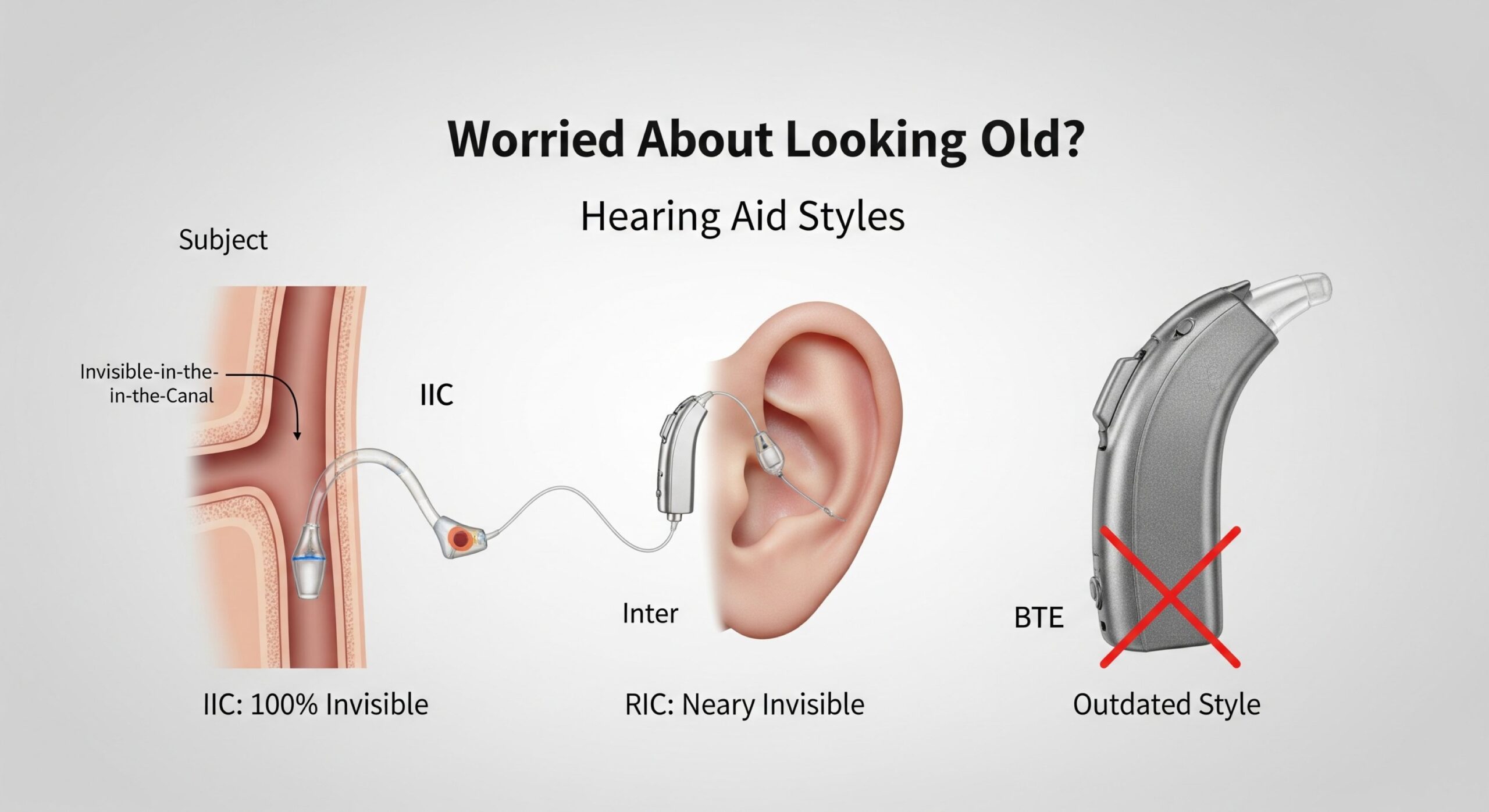
Solution: Truly Invisible Hearing Aid Styles
To solve this, the industry focused on making hearing aids smaller and smarter. For instance, there are two main types of invisible hearing aids that prioritize discretion:
- Invisible-in-the-Canal (IIC): Think of these as the spies of the hearing aid world. A professional custom-molds them to your ear canal so they sit deep inside. As a result, they are truly invisible to others. They work best for mild to moderate hearing loss.
- Receiver-in-Canal (RIC): This is the most popular style in America for a good reason. A tiny case sits hidden behind your ear, often in a color that matches your hair. A nearly invisible wire then tucks into the crease of your ear to deliver exceptionally clear sound. For this reason, it’s considered a top invisible hearing solution.
Ultimately, the conversation has shifted. Using a high-tech device to improve your hearing is no different from wearing glasses to see better. In truth, your hearing loss is far more noticeable than one of today’s nearly invisible hearing aids will ever be.
Can’t Hear in Noisy Places?
This is a real fear, and it’s based on how old hearing aids used to work. Specifically, they simply made everything louder at once: the clatter of silverware, chatter from other tables, and the voice of your companion. It was a recipe for overwhelming noise. In contrast, modern devices work on a totally different principle. They focus on making speech clearer, not just making everything louder.

Solution: Smart Speech Technology
Think of new hearing aids as an intelligent audio filter. They are specifically programmed to isolate and boost human speech while dialing down distracting background noise. For example, they achieve this through several advanced features:
- Directional Microphones: These devices have multiple microphones that work as a team. In a noisy restaurant, for instance, they create a narrow “beam” of focus on the sound in front of you. At the same time, they actively reduce distracting sounds from the sides and back.
- Artificial Intelligence (AI): The smartest hearing aids use AI to scan your surroundings thousands of times per second. Consequently, the AI recognizes different environments—like a car, a library, or a party—and automatically switches to the best program for that situation. You don’t have to do a thing.
- Smartphone Control: In addition, a simple app gives you the ultimate power. You can discreetly boost the speech of the person you’re talking to or turn down background noise with a simple swipe. This gives you personal control in the toughest environments.
So, imagine sitting in that restaurant again. First, the AI identifies the noisy room. Then, the directional mics automatically zoom in on your companion’s voice. If you still need a boost, you can make a quick, subtle adjustment on your phone. It’s a seamless system designed to bring back the natural flow of conversation.
Are They Too Complicated?
Forget about fumbling with tiny batteries or dealing with complex cleaning. Those days are over. Instead, the industry has focused on making devices that are not only effective but also incredibly easy to live with. In fact, they fit seamlessly into your daily routine.
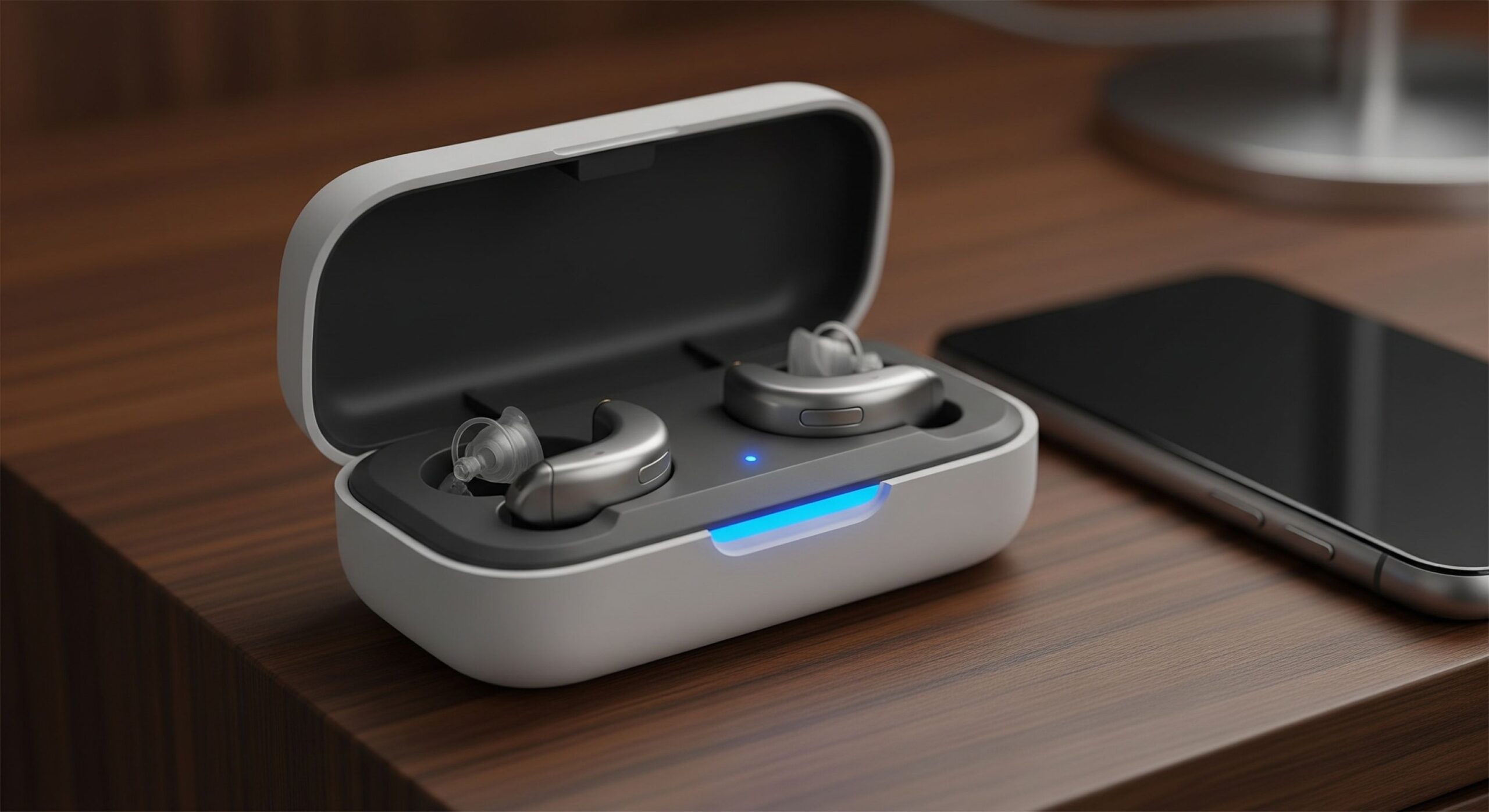
Solution: Rechargeable & Low-Maintenance
The goal of modern hearing aid design is “set it and forget it” simplicity. This is possible because of several key innovations:
- Rechargeable Batteries: Most new hearing aids are fully rechargeable. You simply place them in a sleek charging case on your nightstand, just like your phone. As a result, an overnight charge gives you a full day of worry-free use. This means no more buying or fumbling with tiny batteries.
- Tinnitus Therapy: For the millions of Americans who suffer from tinnitus, many devices include automatic sound therapy. Specifically, they generate a gentle, soothing sound that helps your brain ignore the ringing. Best of all, it works automatically.
- Low Maintenance: Daily care is as simple as wiping the device with a soft cloth. Modern hearing aids use durable materials and advanced nano-coatings to protect them from moisture and earwax. Consequently, this makes them much tougher than older models.
In addition, telehealth has become common. This means your audiologist can often make adjustments and fine-tune your devices remotely. As a result, you save trips to the clinic and get top performance with minimal effort.
What About the Cost?
Let’s be honest: this is the biggest hurdle for many people. Hearing aids are a major investment, and the insurance landscape can be confusing. However, it’s important to understand the full value you get for the price, as it extends far beyond just the devices themselves.

Solution: Understanding Cost & Your Options
That price tag (typically $1,000 to $7,000 per pair) isn’t just for the hardware. Instead, it’s a “bundled” price. This means it also covers the essential services from a hearing professional. Investing in this care is an investment in your success. In fact, it’s the difference between a device that changes your life and one that ends up in a drawer.
Specifically, this bundled care includes the hearing test, professional fitting, and multiple follow-up visits for fine-tuning. It also includes a multi-year warranty. Regarding payment, here is the reality in the U.S.:
- Original Medicare: Does NOT cover hearing aids.
- Medicare Advantage (Part C): This is key. Many of these private plans now offer significant hearing benefits. Therefore, you MUST check your specific plan’s details.
- Veterans Affairs (VA): Provides excellent, often free, hearing aids and care to eligible veterans.
- Private Insurance: Coverage varies wildly. Consequently, you need to call your provider directly to ask about your specific benefits.
- Financing & FSAs/HSAs: Most clinics offer financing plans. In addition, you can also use pre-tax dollars from your Flexible Spending or Health Savings Account to pay.
OTC or Prescription Invisible Hearing Aids?
The arrival of Over-the-Counter (OTC) hearing aids is a game-changer for access, but it has also created confusion. In 2022, for instance, the FDA created the OTC category to improve access and lower costs. While these are for adults who believe they have mild to moderate hearing loss, this path comes with important trade-offs.
Solution: A Head-to-Head Comparison
The right choice depends on your needs, budget, and comfort with technology. While OTC gives you more control, it also means you are responsible for diagnosing your own hearing loss and fitting the device. Here’s a breakdown of the key differences:
| Feature | Over-the-Counter (OTC) | Prescription (with Audiologist) |
|---|---|---|
| Cost | Lower ($200 – $1,500 per pair) | Higher ($1,000 – $7,000+ per pair) |
| Diagnosis | Self-diagnosed (perceived mild to moderate loss) | Professional diagnosis via comprehensive hearing test |
| Fitting | Do-It-Yourself (DIY) setup | Professional fitting, programming, and verification (Real Ear Measurement) |
| Customization | Limited, user-controlled adjustments | Precisely programmed to your specific hearing loss |
| Support | Online or phone support from manufacturer | Ongoing, in-person care and adjustments from an audiologist |
| Best For | Tech-savvy adults with confirmed mild hearing loss and a tight budget. | Anyone who wants a precise solution, has more than mild loss, or wants professional peace of mind. |
In the end, you have to balance cost with comprehensive care. OTC provides an accessible starting point for some. However, the prescription path offers a medically guided, precisely tailored solution. This ensures both safety and the best possible performance for your unique hearing needs, especially for those seeking the best invisible hearing aids available.
More Than Hearing: Your Brain’s Health Is at Stake
Beyond the daily frustrations, there’s an even more compelling reason not to wait. A growing body of research now shows that untreated hearing loss is one of the biggest modifiable risk factors for developing dementia.

This connection comes down to an idea called “cognitive load.” Specifically, when your brain doesn’t get clear sound signals, it’s forced to work overtime. It constantly strains to fill in the gaps and figure out garbled information. This intense effort, therefore, steals valuable mental resources from other critical functions, like memory, focus, and problem-solving. It’s like running a demanding program in the background all day; eventually, the whole system slows down. This can also lead to social withdrawal, which robs the brain of essential stimulation.
A landmark study from Johns Hopkins University found that “the brain spends too many resources trying to decode the garbled sounds it receives… Those resources are then not available for other important functions like memory and thinking.”
Using a hearing aid does more than just make sounds louder. In fact, it gives your brain the clean, crisp audio information it needs to work well. By reducing this cognitive load, you are not just improving your hearing. You are actively preserving your brain’s processing power. In short, treating hearing loss is a direct, proactive step you can take to keep your mind sharp and lower your risk of cognitive decline.
Bonus Section: Future-Proofing Your Investment
Choosing a hearing aid is a big long-term investment. So, beyond immediate hearing improvement, you should consider technologies that will improve your quality of life for years to come. For instance, modern hearing aids are evolving into multipurpose “hearables” with features that go far beyond simple amplification.
Seamless Connectivity: Bluetooth & Streaming
One of the most life-changing features is universal Bluetooth connectivity. Essentially, this turns your devices into personalized, high-fidelity wireless earbuds. You can stream audio directly from your smartphone, tablet, or TV to your hearing aids. This means phone calls, music, podcasts, and movies are all delivered with crystal clarity, tailored to your hearing needs.
Furthermore, this feature gets rid of the struggle of using separate headphones. It also provides a more integrated and convenient listening experience. Whether you’re taking an important call or enjoying your favorite album, the sound is optimized just for you.
Health Monitoring & Advanced Sensors
Leading companies are now building advanced sensors into hearing aids. This turns them into powerful health and safety monitors. Because the ear is a great place to measure biometrics, these devices can now offer features such as:
- Fall Detection: Using built-in sensors, the hearing aid can detect if you have a sudden fall. It can then automatically send an alert to your chosen contacts, giving peace of mind to you and your loved ones.
- Activity Tracking: Many devices can track your steps and physical activity. Consequently, this encourages a healthier lifestyle by helping you monitor your movement goals through the companion smartphone app.
Because of these features, hearing aids are no longer just a tool for better hearing. Instead, they are a central part of a proactive health and wellness strategy.
Your Next Step
The world of hearing aids has been transformed. Indeed, the days of compromise are gone. While the choices may seem complex, the path forward is clear. The single most important action you can take is the first one.

As the Hearing Loss Association of America (HLAA) advises, “Don’t delay. The sooner you get help for hearing loss the better your quality of life will be.”
Scheduling a hearing test is simple and painless. A certified audiologist will measure your hearing precisely and inspect your ears for any medical issues. This complete evaluation, therefore, provides a clear roadmap. It allows you to discuss the specific technologies and styles—including the latest invisible hearing aids—that are best suited to your hearing loss, lifestyle, and budget. In the end, it’s a no-obligation step towards reclaiming the clarity you’ve been missing.
Frequently Asked Questions (FAQ)
Are They Truly Invisible?
Yes, for many users, they can be. The most discreet option is the Invisible-in-the-Canal (IIC) style, which is custom-molded to sit deep within your ear canal, making it completely hidden from view. The most popular style, Receiver-in-Canal (RIC), is another nearly invisible hearing aid. It features a tiny housing behind the ear (often in colors that blend with hair) and a very thin, transparent wire that is difficult to spot unless someone is actively looking for it.
How Do They Handle Noise?
They use smart technology to distinguish speech from noise. Directional microphones work together to create a ‘beam’ of focus on the person speaking in front of you, while advanced algorithms and AI actively suppress distracting sounds from the sides and back. This means they clarify speech rather than just amplifying all sounds, making it much easier to follow conversations in challenging environments.
Does Insurance Cover Them?
Coverage varies significantly. While Original Medicare does not cover them, many private Medicare Advantage (Part C) plans do offer benefits. The VA provides excellent coverage for eligible veterans. For private insurance, you must call your provider directly and ask about your specific ‘hearing aid benefit’ as it can differ greatly from your general health coverage. Always get confirmation of your benefits before making a purchase.
OTC vs. Prescription?
Choose prescription if you want a comprehensive diagnosis, have hearing loss that might be more than mild, or want a solution precisely programmed for your unique needs by a professional. This path also rules out underlying medical issues. Consider OTC if you are tech-savvy, have confirmed (or are very confident you have) only mild hearing loss, and budget is your primary driver. The prescription path offers a higher degree of customization and professional care for your invisible hearing aids.
Why Treat Hearing Loss Early?
Untreated hearing loss forces your brain to work harder to decode sounds, a phenomenon called ‘cognitive load.’ This constant strain diverts mental resources from other important functions like memory and thinking. Over time, this can accelerate cognitive decline. Furthermore, difficulty hearing often leads to social withdrawal, which deprives the brain of vital stimulation. Treating hearing loss reduces this load and keeps the brain more engaged and healthy.
What’s the Adjustment Period?
Yes, and this is completely normal. When you start wearing hearing aids, your brain will begin to process sounds it hasn’t heard clearly in years, which can feel overwhelming at first. Most audiologists recommend a gradual adjustment period, starting with a few hours a day in quiet environments and slowly increasing usage time in more complex settings. It typically takes a few weeks for your brain to adapt and for the new sounds to become natural.
Sources & References
- National Institute on Deafness and Other Communication Disorders (NIDCD) – Information on Tinnitus.
- Johns Hopkins Bloomberg School of Public Health – Research on hearing loss and dementia risk.
- U.S. Food & Drug Administration (FDA) – Ruling on OTC hearing aids.
- Hearing Loss Association of America (HLAA) – Consumer advice and support.
- National Institute on Aging (NIA) – Information on hearing loss and cognitive health.
- American Academy of Audiology (AAA) – Consumer resources.
Worried About Looking Old?
Modern hearing aids are designed to be virtually invisible. The two most discreet styles are Invisible-in-the-Canal (IIC), which sits deep in the ear, and Receiver-in-Canal (RIC), which has a tiny, hidden piece behind the ear.
Can’t Hear in Noisy Places?
Directional Mics
Focus on speech in front of you, reducing sounds from the sides and back.
Artificial Intelligence
Automatically analyzes the environment and adjusts settings for optimal clarity.
App Control
Discreetly fine-tune settings and boost speech from your smartphone.
Today’s technology doesn’t just amplify sound—it clarifies it. Smart features work together to isolate speech and suppress distracting background noise.
Are They Too Complicated?
Designed for simplicity, most new hearing aids are rechargeable. Just place them in a case overnight for a full day of use. They are also low-maintenance and durable, built to resist moisture and earwax.
What About the Cost?
Bundled Value
Price includes the device, professional fitting, follow-up care, and a multi-year warranty.
Payment Options
Check Medicare Advantage, VA benefits, private insurance, or use FSA/HSA funds.
Hearing aids are a significant investment in your health. The price covers not just the technology, but the crucial professional services that ensure your success.
OTC or Prescription?
Over-the-Counter (OTC) is for tech-savvy users with perceived mild loss. The Prescription path involves an audiologist for a precise diagnosis, custom fitting, and ongoing support, ideal for more significant loss or for those who want professional peace of mind.
The Critical Brain Health Link
Untreated hearing loss increases “cognitive load,” forcing your brain to work harder to interpret sound. Research shows this strain is a major risk factor for cognitive decline. Treating hearing loss helps keep your brain sharp.